If your basement has a bedroom or any finished, habitable space, an egress window is not just a “nice to have.” It’s a life safety feature—and replacement windows for basement egress play a critical role in meeting code and ensuring safe escape. In an emergency, it can be the fastest way out and the fastest way in for firefighters or rescue crews.
But here’s where homeowners get tripped up: not every basement window counts as egress, and not every “big window” will pass inspection. The opening has to meet specific size and operation rules, and if the window is below grade, the window well has to meet its own set of requirements too.
This guide walks through replacement windows for basement egress and the IRC egress window requirements, plus practical tips that help you avoid the most common mistakes.
What Makes A Basement Egress Window “Right”?
An egress window has to do two things well:
- Open easily from the inside (normal operation, no weird steps).
- Create enough clear space to climb out (the “net clear opening,” not the glass size).
That “net clear opening” part is huge. The frame, sash, and the way the window opens can eat up space fast.
IRC Egress Window Requirements (The Numbers People Miss)
Local codes can add amendments, but the IRC baseline is the usual starting point for residential egress design. Here are the key minimums commonly referenced:
- Minimum net clear opening area: 5.7 sq. ft. (most situations); 5.0 sq. ft. is allowed for grade-floor openings.
- Minimum net clear opening width: 20 inches.
- Minimum net clear opening height: 24 inches.
- Maximum sill height: the bottom of the clear opening can’t be more than 44 inches above the floor.
And if you have bars, grilles, screens, or covers, they must be releasable from the inside without a key, tool, or special knowledge.
Choosing The Best Window Style For Egress Replacement
When you’re shopping for replacement windows for basement egress, the “best” window is the one that hits the net-clear numbers without turning your basement wall into a construction project.
Casement Windows (Often The Easiest Path)
Casement windows tend to be the most egress-friendly because the sash cranks open and clears the opening more fully. That usually makes it easier to achieve the required net clear opening in a smaller rough opening compared to other styles.
Practical tip: pay attention to how far the window swings into the window well. If the well is tight, you still need the sash to open fully.
Sliding Windows (Can Work, But Measure Carefully)
Sliders can meet egress, but the net clear opening is typically limited because only half the window opens. If your current opening is small, a slider replacement might look larger but still fail the net-clear test.
Double-Hung/Single-Hung (Common “Looks Fine, Fails Inspection” Style)
Hung windows are popular, but for egress, they can be tricky for the same reason as sliders: only part of the unit becomes a usable opening. They can work if the overall unit is large enough, but you usually don’t have as much wiggle room.
Bottom line: don’t pick a style first. Confirm the net clear opening based on the manufacturer’s egress specs for the exact size you’re considering.
Don’t Forget The Window Well (It’s Half The Job)
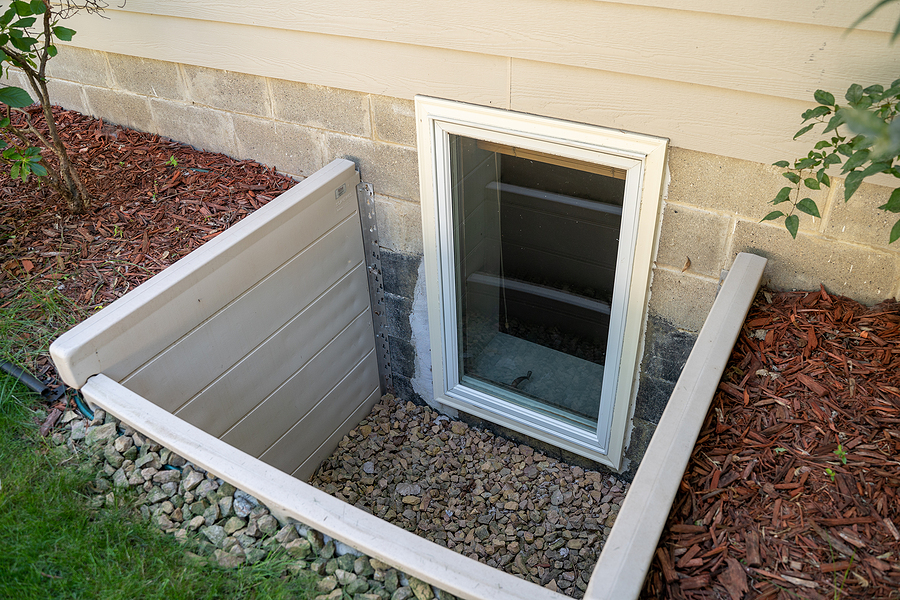
If the egress window is below grade, the window well has to be sized so someone can actually climb out, and so the window can open fully.
Under the IRC, window wells commonly must provide:
- At least 9 sq. ft. of horizontal area
- At least 36 inches of width and projection
- Enough room for the egress window to fully open
If the well is deep, you may also need a ladder or steps to climb out, and there are rules around that too (clearance, projection, and that it can’t block the opening).
Also: plan for drainage. A window well that fills with water is a safety hazard and a basement leak waiting to happen.
A Quick “Pass Inspection” Checklist
Before you commit to a window order, make sure your plan addresses these common fail points:
- You’re measuring net clear opening, not window size.
- The window can be opened from inside without keys/tools, and added security devices don’t break the rules.
- Sill height is within the limit (or you’re planning a code-compliant adjustment).
- The window well meets minimum area/width/projection and allows full window operation.
- You’ve confirmed whether your project needs a permit and inspection (most egress changes do).
Why Work With A Pro For Basement Egress Replacements?
Egress work appears simple until you’re immersed in the details of well dimensions, sill heights, and manufacturer’s spec sheets. A professional can help you pick a replacement window style that’s realistic for your existing opening, and flag issues early (like needing a bigger well, a different window configuration, or changes to interior finishes).
Talk To Semko Inc. About Replacement Windows For Basement Egress
If you’re in the Chicago area and want help selecting and installing the right window style for code-friendly basement egress, Semko Inc. specializes in replacement windows and doors and has been serving the community for decades.
To discuss options for your basement and receive straightforward guidance, please contact us.